Here’s What Bitcoin, ETH, XRP, SOL Max Pain Price Reveals About Upcoming Direction
what Bitcoin, ETH, XRP, and SOL max pain price reveals about market direction, options pressure, and where crypto could move next.

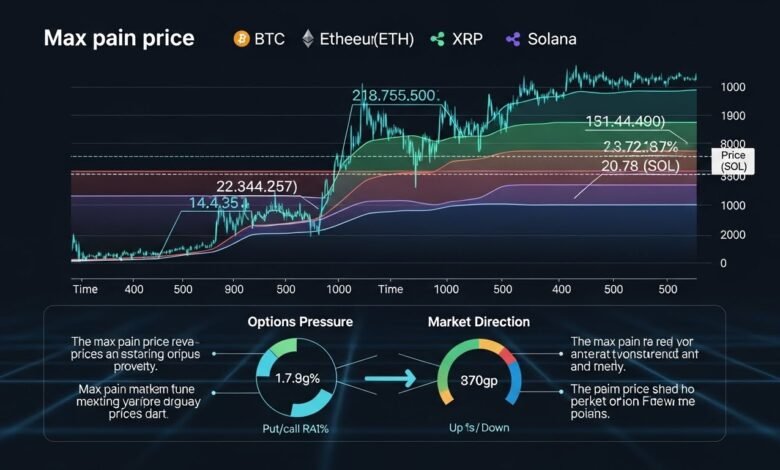
The crypto market often looks chaotic on the surface, with prices jumping on headlines, whale activity, and macroeconomic shifts. But beneath the noise, there’s a powerful, repeatable force that can influence short-term direction more than many traders realize: the options market. Specifically, the concept known as the max pain price has become one of the most discussed tools for understanding where price pressure might pull major coins like Bitcoin, ETH, XRP, and SOL as key expiry dates approach.
Max pain price isn’t magic, and it isn’t a guarantee. But it provides a logical framework for why prices sometimes drift toward certain levels right before options expiration, and why sudden reversals can happen when that “magnet” disappears. If you’ve ever wondered why Bitcoin stalls near a round number, why Ethereum keeps rejecting a zone that looks breakable, or why XRP and Solana sometimes surge only to snap back quickly, the max pain price can offer a meaningful explanation.
This article breaks down what max pain price means, how it works across Bitcoin, ETH, XRP, and SOL, and what it may reveal about upcoming direction. You’ll also learn how to combine max pain price with other signals such as open interest, options expiry, implied volatility, put-call ratio, support and resistance, and broader market sentiment so your analysis doesn’t rely on one indicator alone. By the end, you’ll have a clear way to interpret max pain price dynamics without falling into the trap of overconfidence.
Understanding Max Pain Price and Why It Matters
Max pain price is a concept derived from crypto options data. In simple terms, it is the strike price at which the most options contracts expire worthless, creating the greatest financial “pain” for options buyers and the least payout from options writers. This matters because, as options expiry approaches, market forces sometimes push spot prices toward the max pain price, especially in heavily traded assets like Bitcoin and Ethereum.
To understand why, you need to recognize that options markets are not just a side show. In major cryptocurrencies, options volume can be massive, and positioning can influence short-term price behavior. When a large number of call and put options are open at certain strikes, market makers and hedgers adjust exposure dynamically. Those hedging activities can create real buying or selling flows in the spot and futures markets.
When traders talk about max pain price as a “magnet,” they’re describing the tendency for price to drift toward the level where the options market is most balanced from a payout perspective. That drift can become more noticeable when liquidity is thin, volatility is elevated, and the market is indecisive.
How the Max Pain Price Is Calculated
Max pain price is calculated by examining the distribution of open options contracts across strike prices and estimating the total payout to option holders if price were to settle at each strike at expiry. The strike with the lowest total payout is the max pain price.
In practice, this means analysts look at where the heaviest concentration of call options and put options sits and where those positions would lose the most. When the largest amount of open interest clusters around specific strikes, those strikes become more influential. This is why max pain price tends to be more useful on assets with deep options liquidity, like Bitcoin and ETH. XRP and SOL can still show meaningful patterns, but the reliability depends on the maturity and liquidity of their options markets.
What Max Pain Price Reveals About Upcoming Direction
Max pain price can reveal three important things about upcoming direction: First, it highlights where the market expects the most “neutral” settlement near expiry, especially if there is no strong bullish or bearish catalyst. Second, it shows where the largest positioning battles are happening, since heavy open interest around certain strikes often forms a short-term gravitational zone.
Third, it can help explain why breakouts sometimes fail near expiry. If price pushes above a call-heavy region but max pain price is lower, hedging pressure can contribute to a pullback. However, max pain price is not a standalone trading signal. It is best used as a context tool, combined with trend analysis, volume, liquidity, and broader derivatives data.
Why Bitcoin Max Pain Price Often Acts Like a Magnet

Bitcoin is the center of the crypto derivatives universe. Because Bitcoin options are highly liquid, the max pain price for Bitcoin can sometimes align closely with the price action during expiry week. This doesn’t mean Bitcoin always closes at max pain price, but it often trades around it, especially when the market lacks a strong directional catalyst.
When Bitcoin max pain price sits near a major psychological level, such as a clean round number, its influence becomes even stronger. That’s because spot traders, futures traders, and options hedgers all pay attention to those levels, amplifying the effect.
Bitcoin Max Pain Price and Market Maker Hedging
A key driver behind max pain behavior in Bitcoin is hedging, especially delta hedging. When traders buy call options, market makers often hedge by buying Bitcoin. When traders buy put options, market makers hedge by selling Bitcoin. As Bitcoin price moves, the delta of those options changes, forcing market makers to adjust hedges.
Near expiry, hedging flows can intensify because option sensitivity increases. This is where max pain price can matter most. If Bitcoin trades above the max pain price with heavy call open interest below, hedging adjustments can create downward pressure that pulls price back toward that max pain zone. If Bitcoin trades below max pain price with heavy put open interest above, hedging adjustments can create upward pressure toward the max pain price.
What Bitcoin Max Pain Price Signals for Next Direction
Bitcoin max pain price can signal whether the market is likely to chop sideways or attempt a breakout. If Bitcoin is trending strongly and momentum is high, max pain price may be ignored as traders push directionally. But if Bitcoin is stuck in a range and volatility is compressing, max pain price becomes more relevant.
In many cases, a Bitcoin max pain price close to current price suggests a consolidation bias, meaning price may drift sideways into expiry. If the max pain price is far above or far below current price, it can signal larger tension in positioning, potentially increasing volatility as expiry approaches. The most important takeaway is that Bitcoin max pain price tends to be a short-term influence, not a long-term predictor. It helps interpret near-term direction, especially when combined with funding rates, liquidation levels, and order flow.
ETH Max Pain Price and the Battle Between Volatility and Structure
Ethereum has one of the most active options markets in crypto, and ETH max pain price is closely watched around weekly and monthly expiries. ETH often behaves differently from Bitcoin because Ethereum has unique catalysts such as network upgrades, staking dynamics, and ecosystem-driven narratives like DeFi and tokenization trends. Because of these factors, ETH max pain price can sometimes be overridden by strong fundamental catalysts, but it remains highly relevant during calm periods or when the market is waiting for a bigger macro signal.
How ETH Max Pain Price Interacts with Implied Volatility
ETH tends to carry a different implied volatility profile compared to Bitcoin. When implied volatility rises, options premiums become more expensive, and traders often position more aggressively. This can increase the strength of max pain price effects because hedging flows become larger relative to spot liquidity. When ETH max pain price sits near a key technical level, such as a range midpoint or a widely watched support zone, ETH can “pin” to that level into expiry. This pinning behavior often frustrates traders expecting directional continuation, especially when ETH repeatedly rejects a breakout level.
What ETH Max Pain Price Reveals About Upcoming Direction
ETH max pain price can reveal whether Ethereum is likely to remain range-bound or if it’s approaching a volatility release. If ETH price is hovering near max pain price and open interest is heavy, it can signal that the market is comfortable with current levels and is positioning for neutral settlement.
However, if ETH trades far from max pain price and options positioning is extreme, it can indicate that the market is vulnerable to sharp moves. Those moves can happen when hedging flips from stabilizing price to amplifying direction, particularly when gamma exposure shifts. In practical terms, ETH max pain price often suggests caution around expiry, especially for short-term traders. It can also help identify when ETH is more likely to whip around key levels, rather than trend smoothly.
XRP Max Pain Price and How It Reflects Speculative Positioning
XRP is a unique case because its price action can be heavily influenced by news-driven sentiment, retail participation, and sudden shifts in narrative. While XRP options markets are not always as deep as Bitcoin or ETH, XRP max pain price can still provide valuable clues about short-term direction, especially when there is meaningful open interest on major venues. Because XRP often experiences sharp spikes and pullbacks, the max pain price can act as an anchor during expiry week, pulling price back toward a level where large options positions settle with minimal payout.
XRP Max Pain Price and the Role of Rapid Sentiment Shifts
XRP is known for quick sentiment swings. When the market gets bullish, call buying can increase rapidly. That shifts the options distribution and can move the max pain price higher. When sentiment cools, put demand can rise, moving the max pain price lower. This fluidity makes XRP max pain price especially useful as a snapshot of how traders are positioned right now. It reflects whether traders are leaning bullish or bearish, and whether the market is setting up for a squeeze in either direction.
What XRP Max Pain Price Reveals About Upcoming Direction
If XRP is trading above its max pain price near expiry, it can signal that downside pinning pressure may exist, especially if a large amount of call open interest sits below current price. This doesn’t mean XRP must fall, but it suggests the market may struggle to sustain a breakout unless there is a strong catalyst.
If XRP is trading below its max pain price, it can signal potential upward drift into expiry, particularly if puts dominate above. The key is understanding that XRP max pain price is often more about volatility control than trend prediction. It can help you set realistic expectations for whether XRP is likely to surge, chop, or revert. Because XRP frequently reacts to headlines, combining XRP max pain price with volume analysis, liquidity zones, and support and resistance is essential. The max pain price reveals positioning; price direction still depends on catalyst strength and market environment.
SOL Max Pain Price and Its Link to Momentum and Liquidity
Solana has become one of the most actively traded altcoins, and SOL max pain price is increasingly relevant as options markets expand. SOL is a momentum-driven asset, often moving faster than Bitcoin and ETH, especially during altcoin rotations. That means SOL max pain price can influence price action, but the effect is often more volatile and less stable than in Bitcoin. SOL’s tendency toward sharp swings means the max pain price can sometimes look “wrong” early in the week and become relevant only closer to expiry as hedging pressure builds.
Why SOL Max Pain Price Can Be a Volatility Trigger
In fast-moving assets like SOL, max pain price can be less of a magnet and more of a volatility trigger. When SOL price diverges far from max pain price, it can set up a scenario where hedging flows amplify movement. If the market is heavily positioned with calls, a sudden dip can cascade into a larger move as hedges unwind. If the market is heavy on puts, a sudden rally can force hedging in the other direction. This is why SOL max pain price should be interpreted alongside liquidation heatmaps, funding rates, and momentum indicators. SOL doesn’t just drift; it snaps.
What SOL Max Pain Price Reveals About Upcoming Direction
SOL max pain price can reveal whether the market is leaning toward consolidation or whether a momentum breakout is likely to continue. If SOL trades near max pain price, it may suggest range conditions into expiry. If SOL trades far above max pain price, it may indicate the rally is extended relative to options positioning, increasing the risk of mean reversion or a sharp pullback.
But SOL is also sensitive to ecosystem narratives and broad risk-on sentiment. If the overall crypto market turns bullish, SOL can ignore max pain price and trend strongly. In those cases, max pain price becomes less predictive and more of a reference point for where pullbacks may stabilize.
How to Use Max Pain Price Without Overtrusting It
The biggest mistake traders make is treating max pain price like a guaranteed target. It isn’t. Max pain price is a probability-weighted insight based on positioning, and positioning can change quickly as traders roll contracts, close positions, or open new ones. To use max pain price effectively across Bitcoin, ETH, XRP, and SOL, you need to treat it as a context signal, not a command.
Combine Max Pain Price With Key Derivatives Signals
Max pain price becomes more informative when paired with the put-call ratio, which shows whether traders are buying more puts or calls. It also becomes clearer when combined with open interest changes, since rising open interest near certain strikes can strengthen the max pain zone. Another helpful layer is implied volatility. If implied volatility spikes, it suggests traders are expecting movement, which may reduce the pinning effect and increase the odds of breaking away from max pain price.
Use Max Pain Price With Technical Structure
Max pain price works best when it aligns with clear technical zones. If Bitcoin max pain price sits near a strong support region, that strengthens the chance of price stabilizing there. If ETH max pain price aligns with a major resistance, it can increase the chance of rejection or sideways chop. For XRP and SOL, max pain price may align with range boundaries or liquidity clusters. When that happens, it can become a practical tool for identifying where price might “gravitate” during expiry week.
Understand When Max Pain Price Stops Working
Max pain price tends to lose influence when the market is driven by strong catalysts or extreme momentum. A major macro event, a sharp Bitcoin breakout, or a sudden risk-off move can overpower options pinning effects. Max pain price also becomes less reliable when options liquidity is thin, especially in smaller assets. This is why SOL max pain price and XRP max pain price need extra confirmation from volume and volatility signals.
What the Max Pain Price Reveals About Overall Crypto Direction
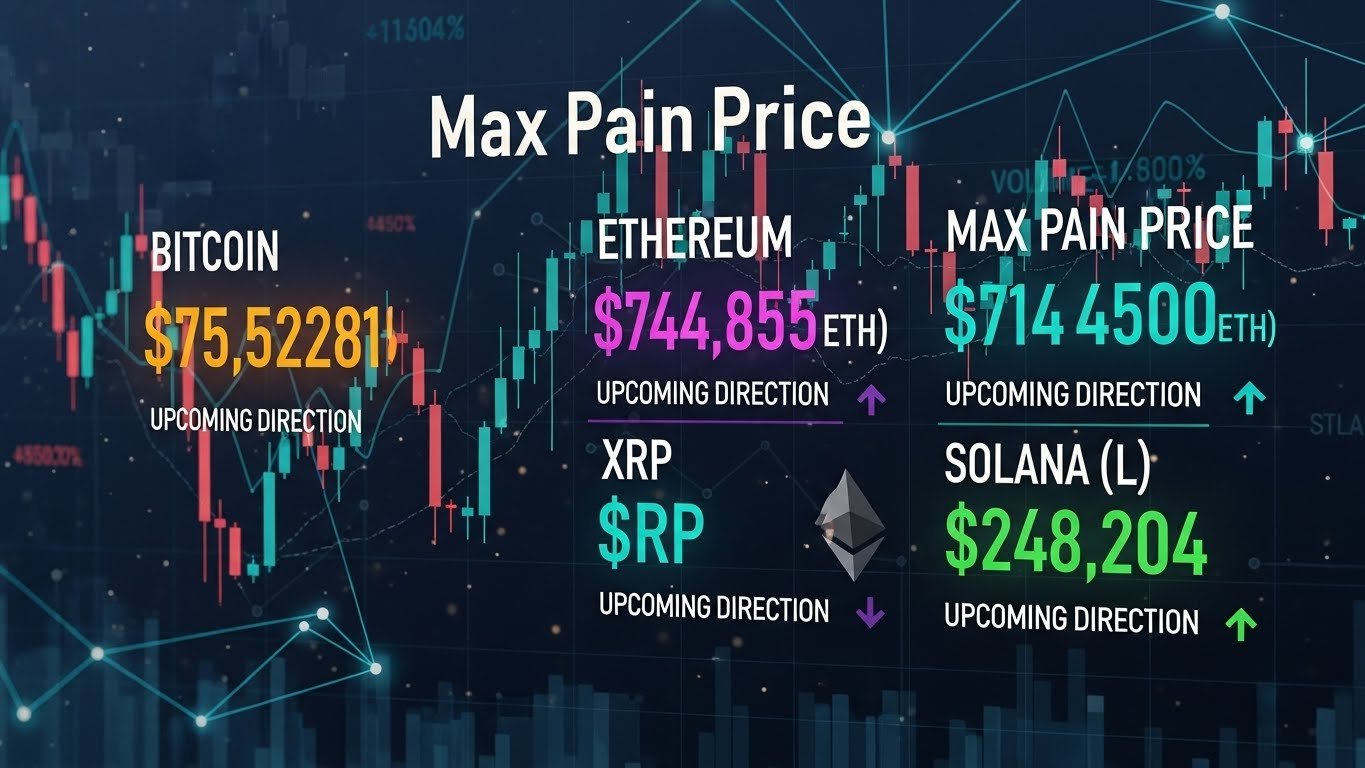
When you observe Bitcoin, ETH, XRP, and SOL max pain price together, you gain a broader view of market positioning. If max pain prices cluster near current spot levels across multiple coins, it often signals a market that is leaning toward consolidation. That environment typically produces range trading, fakeouts, and choppy movement.
If max pain prices are significantly below current prices across major coins, it can indicate that the options market is positioned defensively, possibly increasing downside risk into expiry. If max pain prices are significantly above current prices, it can suggest bullish positioning, but also potential for volatility if momentum stalls.
Importantly, max pain price can also reveal which asset is most likely to move. If Bitcoin max pain price is very close to spot, but ETH max pain price is far away, Ethereum may be the one that experiences stronger directional movement as the market resolves positioning stress. In that sense, max pain price isn’t just about one coin. It’s a window into market mechanics and how liquidity, hedging, and trader sentiment interact.
Conclusion
Bitcoin, ETH, XRP, and SOL max pain price offers a powerful lens into short-term market direction, especially around options expiry. While it is not a guarantee and should never be treated as a single-point prediction tool, the max pain price helps explain why price often drifts toward specific levels, why breakouts can fail, and why sudden reversals can appear when hedging pressure shifts.
Bitcoin max pain price tends to be the most reliable due to deeper liquidity and more mature options markets. ETH max pain price is highly relevant but can be influenced by volatility and ecosystem catalysts. XRP max pain price reflects speculative positioning and sentiment shifts, often acting as an anchor in choppy markets. SOL max pain price can be both a magnet and a volatility trigger due to Solana’s fast momentum style and evolving derivatives landscape. For the best results, use max pain price alongside open interest, put-call ratio, implied volatility, market sentiment, and strong technical structure. When you do that, max pain price becomes less of a mystery and more of a practical guide to what the market is likely to do next.
FAQs
Q: What is max pain price in crypto options, and why does it influence Bitcoin and Ethereum?
Max pain price in crypto options is the price level where the largest number of options contracts expire worthless, creating the lowest total payout to option holders. It can influence Bitcoin and Ethereum because large options markets require hedging activity, and those hedging flows can create pressure that nudges spot price toward the max pain price as expiry approaches. While it doesn’t control the market, it often shapes short-term direction in quiet or range-bound conditions.
Q: How reliable is the Bitcoin max pain price for predicting short-term direction before options expiry?
Bitcoin max pain price can be useful for understanding short-term direction, but it’s not a guaranteed prediction. It tends to be more reliable when Bitcoin is consolidating, volatility is moderate, and options open interest is concentrated near key strikes. It becomes less reliable when major news, strong momentum, or macro events push Bitcoin into a decisive trend that overpowers options-related pinning pressure.
Q: Why do ETH max pain price levels sometimes fail to “pin” Ethereum even when open interest is high?
ETH max pain price can fail to pin Ethereum because implied volatility and ecosystem catalysts often play a bigger role in ETH than in many other assets. If traders expect a major move, hedging may amplify volatility rather than stabilize price. Ethereum can also ignore max pain price when strong buying or selling flows enter from spot markets, institutional positioning, or narrative-driven demand that shifts price direction regardless of options settlements.
Q: Can XRP max pain price and SOL max pain price be used the same way as Bitcoin max pain price?
XRP max pain price and SOL max pain price can be used similarly, but with more caution. Bitcoin has deeper options liquidity, making its max pain dynamics more consistent. XRP and SOL can still show max pain effects, especially near expiry, but they are more sensitive to sudden sentiment changes and momentum swings. This means traders should combine XRP max pain price and SOL max pain price with additional confirmation from volatility, volume, and liquidity analysis.
Q: What is the best way to combine max pain price with other indicators to avoid false signals?
The best approach is to treat max pain price as context and confirmation rather than a target. Combine it with open interest changes to see where positioning is growing, put-call ratio to gauge bullish or bearish sentiment, implied volatility to estimate expected movement, and technical tools such as support and resistance and trend structure. When max pain price aligns with strong technical zones and derivatives signals support it, the probability of meaningful influence increases; when those signals conflict, it’s a warning to expect volatility or deviation.